November 26, 2025
The American Academy of Pediatrics (AAP) recommends avoiding screens for children under 18 months. For children 18–24 months, the recommendation is to limit time to high-quality programming and co-viewing with a parent. For children 2–5, the AAP recommends limiting screen time to one hour of high-quality programs, daily.
The AAP states that “children younger than 2 learn best from exploring the world around them and playing with other children and adults….”
AAP is not alone in its recommendations. The Journal of the American Academy of Child & Adolescent Psychiatry states that “while screens can entertain, teach, and keep children occupied, too much use or the wrong content may lead to problems.”
Those problems can impact future social and cognitive development. According to the National Institutes of Health, “There is solid evidence that infants and toddlers have difficulty transferring new learning from a 2D representation to a 3D object (e.g., from screen to real life)…. By contrast, they learn intensely through face-to-face interaction with parents and caregivers. Early learning is easier, more enriching and developmentally more efficient when experienced live, interactively, in real time and space, and with real people.”
Additionally, “some studies associate prolonged TV viewing with lower cognitive abilities, especially related to short-term memory, early reading and math skills and language development,” according to the NIH.
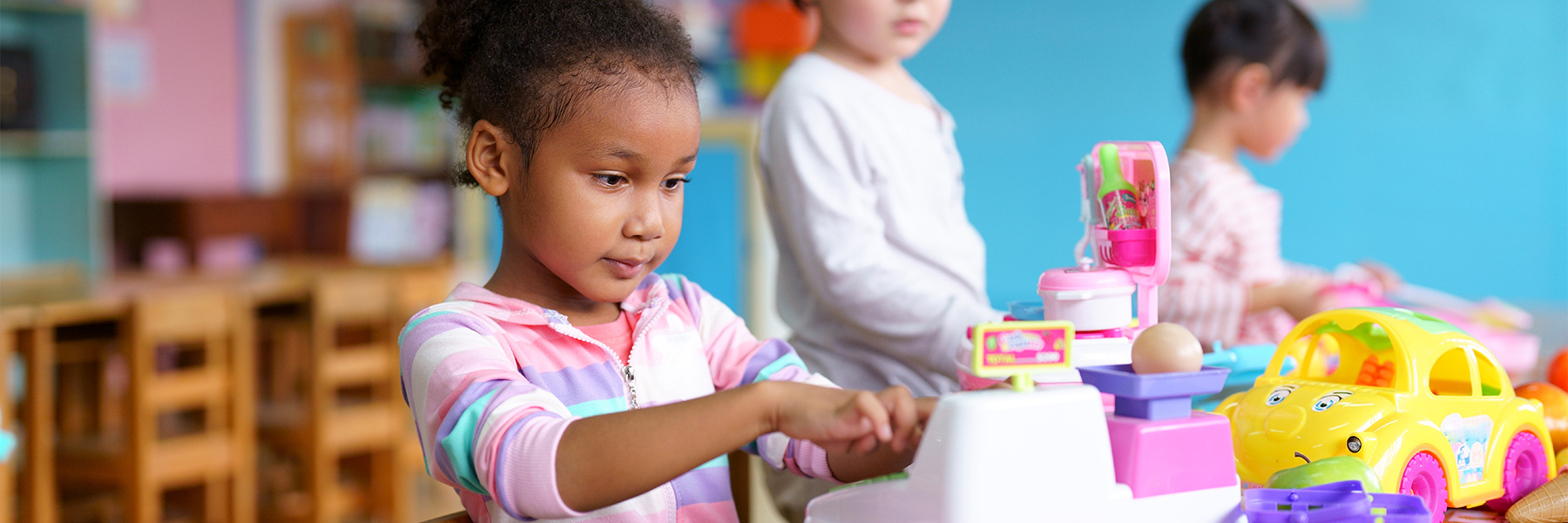
Screen-free early learning is the foundation of Fraser Preschool & Childcare Center’s teaching model. School Director Chris Bentley says, “Fraser School® encourages social interactions through a play-based environment. Play is a foundation for development and is the primary tool children use to learn.”
At Fraser Preschool & Childcare Center, each child is guided toward development of early learning and socialization skills. Children receive individual playtime, so they can explore their environment, and they have daily movement and exploration opportunities in the indoor gym and/or playground. Group times help children learn structure, by sitting together to hear stories or songs. And children explore music through rhythm, movement, and song, twice per week.
Bentley says, at a time when more early childhood programs are pushing children to adapt technology, Fraser Preschool & Childcare Center focuses on the basics of social and emotional development for children.
Children are taught about their emotions, such as identifying them while we validate them and talk through choices in response to these emotions. Through this, children learn to establish and sustain positive relationships with other children and teachers. While interacting in a meaningful way, they learn to participate cooperatively and constructively, balancing their own needs and rights with those of others.
Additionally, Fraser Preschool & Childcare Center focuses on physical development, language development, and cognitive development for children.
“We use a traditional approach to childhood learning,” says Bentley. “We believe that play periods are as important as time spent in a structured learning environment; children need opportunities to be active learners through play, exploration, and constructive learning; hands-on interactions with objects and diverse people help children begin to figure out how the world works; and that all children develop differently. We support their early development and set them up for lasting educational success.”
Fraser Preschool & Childcare Center is also different in a significant way: all infant, toddler, and Pre-K programs are inclusive – with a mix of children with typical needs and those with neurodivergence, developmental, or intellectual needs.
According to the National Professional Development Center on Inclusion, inclusive environments encourage better social development for both groups of children. The Early Childhood Research Quarterly journal states that parents of children in inclusive preschool programs are more satisfied with their children's schooling, regardless of whether their child has special needs.
Inclusive learning environments also use practices developed for children with special needs which falls into the theory of universal design. What benefits one targeted group is even more broadly beneficial to a larger population. Practices like giving children choices about how they complete tasks, using positive reinforcement and making communication easier through visual strategies can also be used at home.
Fraser Preschool & Childcare Center is currently accepting applications. To schedule a tour and learn more, click here.